Botanical Intelligence: What Plants Have Taught Me Through Aromatherapy
One of the greatest privileges of working with essential oils for many years is that you begin to recognise the unique character of each plant.
Every botanical has its own aroma, chemistry and character. At first, you may simply recognise an essential oil by its fragrance. But the more time you spend working with it, the more you begin to notice. You learn how it changes within a blend, which other oils it complements, how its aroma develops over time, and how differently people can respond to it.
For me, aromatherapy has never been only about creating formulations. It is also about observation.
The plants themselves are remarkable teachers.
Why plants from different climates can be so different
Plants grow in response to the environments around them.
A tree that survives long, cold winters faces very different growing conditions from a flower growing in a warm Mediterranean climate. Citrus trees flourish in warmth and sunshine, while many conifers are adapted to frost, wind and snow.
Growing conditions, including climate, soil, altitude, rainfall and the timing of harvest, can influence the chemical composition and aromatic character of the plant material from which an essential oil is produced.
But there is also the way we experience those aromas.
Citrus oils are often described as bright or uplifting. Mediterranean herbs can smell fresh and stimulating. Woods and resins are frequently experienced as warm, deep or grounding.
These descriptions are not scientific classifications. They are part of the language we use to describe our experience of aroma.
Whether we are considering chemistry, aroma, growing conditions or simply the individual character we perceive in a plant, each botanical brings something different.
That individuality is one of the things I find so fascinating about aromatherapy.
What extraction method changes about an essential oil
How an aromatic extract is produced plays an important part in what eventually reaches the bottle.
Many essential oils are obtained through steam distillation. Citrus oils are commonly expressed or cold pressed from the peel. Some delicate flowers are processed using solvent extraction, producing an aromatic extract known as an absolute rather than an essential oil.
These methods are not interchangeable.
Different extraction processes can capture different proportions and types of aromatic compounds. As a result, extracts from the same botanical material may have noticeably different aromas and characteristics depending on how they were produced.
Understanding how an oil or aromatic extract was obtained gives us another piece of information about what we are working with.
For me, this matters because aromatherapy is not simply about reading the name printed on a bottle. The plant, the part of the plant, the growing conditions and the method of extraction all contribute to the finished material.
Why different parts of the same plant can produce very different oils
Even within a single plant, different parts can give us remarkably different aromatic materials.
Flowers, leaves, bark, roots, seeds, fruit and peel each perform different functions for the plant, and their chemical composition can differ accordingly.
One of my favourite examples is the bitter orange tree.
From its flowers we obtain neroli essential oil. The leaves and young twigs give us petitgrain essential oil. The peel of the fruit gives us bitter orange essential oil.
They all come from the same tree, yet when you smell them side by side, they are clearly different.
Neroli has the distinctive floral character of the blossom. Petitgrain has a greener, leafier character. Bitter orange brings the recognisable freshness of citrus peel.
For someone beginning to learn aromatherapy, this can be quite surprising. We tend to think of a plant as one thing, yet the bitter orange tree shows beautifully how much diversity can exist within a single botanical species.
It is also a reminder that when we work with an essential oil, we are not simply working with “orange” or “lavender” or “rose”. Understanding which part of the plant produced the oil is part of understanding the material itself.
This diversity is one of the reasons aromatherapy remains endlessly fascinating to me.
Why some plant combinations naturally support each other
When I blend essential oils, I am not only considering the individual oils. I am observing what happens when they are brought together.
Some combinations seem naturally harmonious.
Lavender and sweet orange, frankincense and cedarwood, rosemary and peppermint, rose and sandalwood are examples of combinations where the individual aromas can complement one another.
But a successful blend is not simply a matter of putting two pleasant-smelling oils together.
I listen to what happens to the aroma.
Does one oil dominate everything else? Does another disappear? Does the blend need something lighter, softer or deeper? Does each botanical still have a place, or have I added something that does not need to be there?
Sometimes the answer is to add another drop. Just as often, the answer is to take something away.
This is where repeated experience becomes important. Over time, you begin to recognise how certain oils behave together and how a very small adjustment can change the character of the whole formulation.
For me, good blending is less about creating dramatic contrasts and more about allowing each botanical to play its part.
What I have learned by working repeatedly with the same botanical oils
The longer I work with an essential oil, the more I appreciate its subtle qualities.
Its aroma usually comes first. Later, I begin recognising how it behaves in different formulations, what happens when the proportions change, how it develops alongside other oils, and how different people experience it.
An essential oil can also vary from one batch or harvest to another. Plants are natural materials, and growing and production conditions are not identical every year.
At the same time, the person experiencing the aroma is never completely predictable either.
An aroma I find beautiful may not appeal to someone else. A person may love an oil at one stage of life and feel quite differently about it later. Memory, association and personal preference all become part of the experience.
Yet, with repeated use, patterns begin to emerge.
That kind of understanding develops slowly.
Books and formal study are important. They gave me the foundation for understanding essential oils, their chemistry, traditional uses and safe application.
But there is another kind of knowledge that comes only from working with the materials repeatedly.
You smell. You formulate. You observe. You adjust. And then you do it again.
Over the years, those observations accumulate.
Why aromatherapy is as much observation as formulation
Creating a blend is only one part of aromatherapy.
The other part is paying attention.
I observe the plants and the aromatic materials they produce. I learn their qualities. I notice how they interact with one another and how changing a small part of a formulation can alter the whole experience.
Most importantly, I listen to the people who use the blends.
Every formulation teaches me something.
Sometimes it confirms what I expected. Sometimes a botanical behaves differently within a blend than I imagined. Sometimes another person’s response makes me notice something I had previously overlooked.
That is why I don’t see formulation as something that is ever completely finished as a field of learning.
For me, aromatherapy is a patient conversation with the botanical world. The formulas may change, but the need to observe remains the same.
I don’t believe we ever completely know a plant.
Every season, every harvest, every new blend can reveal another aspect of its character.
And after many years of working with essential oils, that is still one of the things that keeps my work as an aromatherapist endlessly inspiring.
-
-
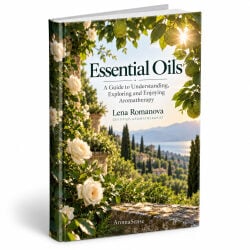
Essential Oils Guide
- Add to cart
- $15.00 Incl. GST
-